
Sales
TikTok Shop: brand registration, categories, and content that actually sells
Wherever TikTok Shop is open, it is a full store: local checkout, and content that is the storefront. Registration, categories, and videos that sell.
9 min readUpdated 2026
Wherever TikTok Shop is open, a buyer can finish the order without leaving the app: from a For You video, a LIVE, the brand profile, or the Shop tab. The shop is built around local habits — the payment methods and carriers people already use in that country — which is what removes the two barriers social commerce usually trips over: paying, and getting the parcel.
For brands, that means TikTok stops being only a reach channel. It is a full store, where content is the storefront and the creator is the seller. That is why the rules differ from a marketplace listing or from your own shop. Markets do not open on the same day, and the documents, fees, and limits are the ones for the country you select in Seller Center.
What changes once the shop is open
Early sellers in a market often sit inside a promotional commission window. Check in Seller Center when yours ends — the rate after that window is the one your margin has to survive. Anyone starting into a peak season (Black Friday, local gift holidays) gets the best moment for impulse purchases, and the most crowded one.
Brand registration: the documents that matter
TikTok Shop is a channel for companies, not private accounts. In Seller Center, choose the country you are registering in and put these in one folder. The exact names differ by country; this is the set reviewers ask for almost everywhere:
- —A business-registry extract for your company type.
- —Tax ID, and proof of VAT or sales-tax registration if it applies.
- —ID for the person representing the company.
- —A business bank account in the country of registration, for settlements.
- —A returns policy with a return address in that market.
- —Product documents that depend on the category. In the EU those are often a CPNP notification for cosmetics, CE marking for electronics, and EN71 for toys. Other markets use their own names for the same idea: a cosmetics notification, a conformity mark, a toy-safety standard.
Verification usually takes a few business days. With a complete folder the form itself is about fifteen minutes — brands lose the most time hunting for scans halfway through.
Costs
There is no single global rate. The usual shape is a sales commission, with no subscription and no listing fee, and some markets offer a lower introductory rate for the first months after registration. Electronics are often a different band from the rest of the catalog. On top of the platform fee come creator commissions, samples, and any ads. Rates change and they differ by country, so before you calculate margin always read the current terms in Seller Center for your market.
Follower count
Most sources confirm that a seller does not need a minimum number of followers to open a shop — company verification is what counts. Follower thresholds tend to apply to features (LIVE or linking on your own account, for example) and to affiliate creators, and those thresholds differ by market. If you come across a number, verify it in the panel for your country. A lot of conflicting figures are copied from other markets.
Brand and category authorization
This is the step that surprises new brands most often.
Brand authorization. If you sell your own brand, prepare proof that it is yours — a trademark registration from your national office or a regional one (EUIPO in the European Union), or at least proof of filing. If you sell someone else’s brands (distribution, resale), you need written authorization from the brand owner or an official distributor. Without it, products can be blocked even after the company passes verification.
Category authorization. Some categories are open immediately (fashion, accessories, home), and some need extra approval and documents: cosmetics, dietary supplements, food, children’s products, electrical devices. For beauty the usual essentials are a cosmetics notification, the responsible person, a safety report, and labels in the language of the market. Supplements and functional food may also need manufacturing certificates and a filing with the local authority.
Points that need a case-by-case check. A general checklist will not settle everything. Check the prohibited and restricted products policy for your country:
- —products with health or “medical” claims (including cosmetics that promise to “cure acne”),
- —kits that mix categories (a cosmetic plus a supplement in one box, for example),
- —products with batteries, flammable liquids, or aerosols (shipping limits),
- —cross-border selling, including Sell Across Europe where that feature is available (label language, and compliance with the destination country’s law),
- —digital products — ebooks, courses, and templates are not goods in TikTok Shop, so you sell them outside the shop (more in the 4-week plan and ebooks).
Brand content that sells
On TikTok Shop, content is not an add-on to the offer — it is the offer. A few rules that separate videos that sell from videos that only “look” like they should. These hold in every market.
Native feel
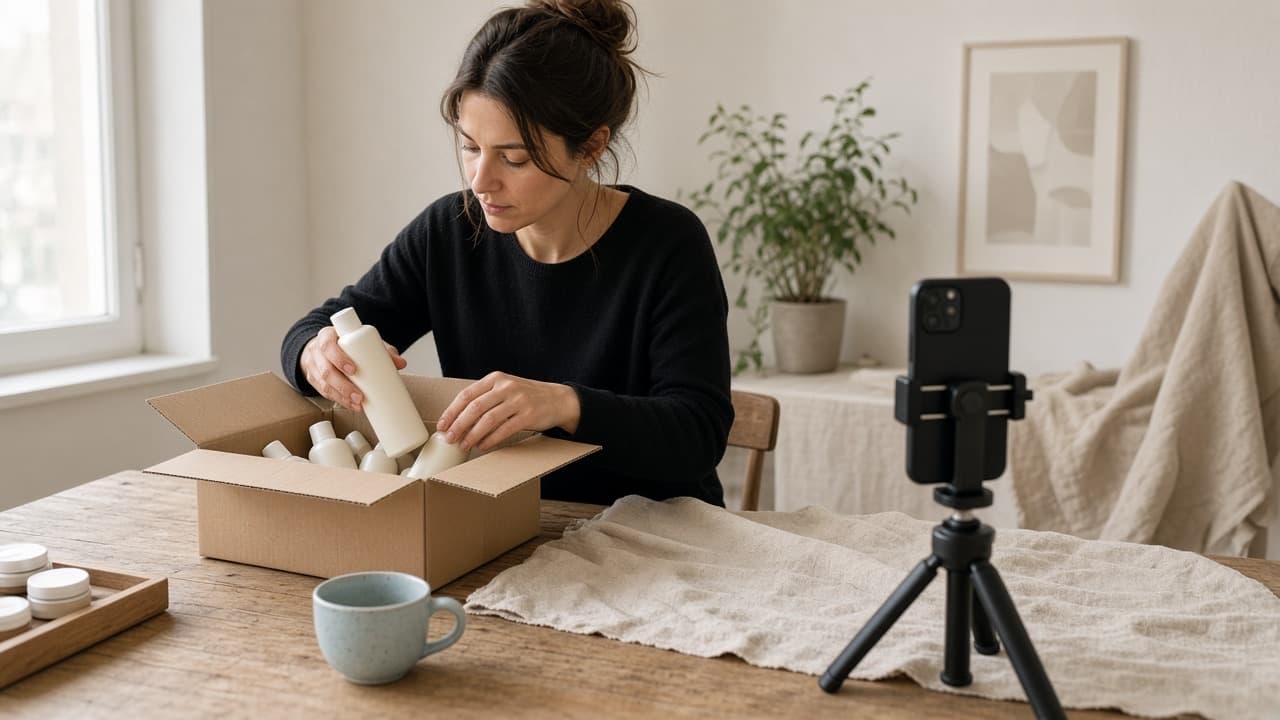
The video should look like TikTok, not like a television ad. Vertical 9:16, natural light, a human face, talking to the camera, captions in the language of the viewer. Generative AI made a perfect image stop being the differentiator — algorithms and viewers look for originality, context, and a real person. A phone recording in the lab, the warehouse, or while packing parcels often beats a studio shoot.
The hook and the first seconds
You have 1–3 seconds. If people swipe after two, distribution gets cut. Hook types that hold up:
- —Problem: “If your cream pills under foundation, do this test.”
- —Contrast / result: show the outcome first, the explanation later.
- —Surprise: “We make this product in a lab 200 meters from here.”
- —A question to a specific person: “Combination skin and nothing works?”
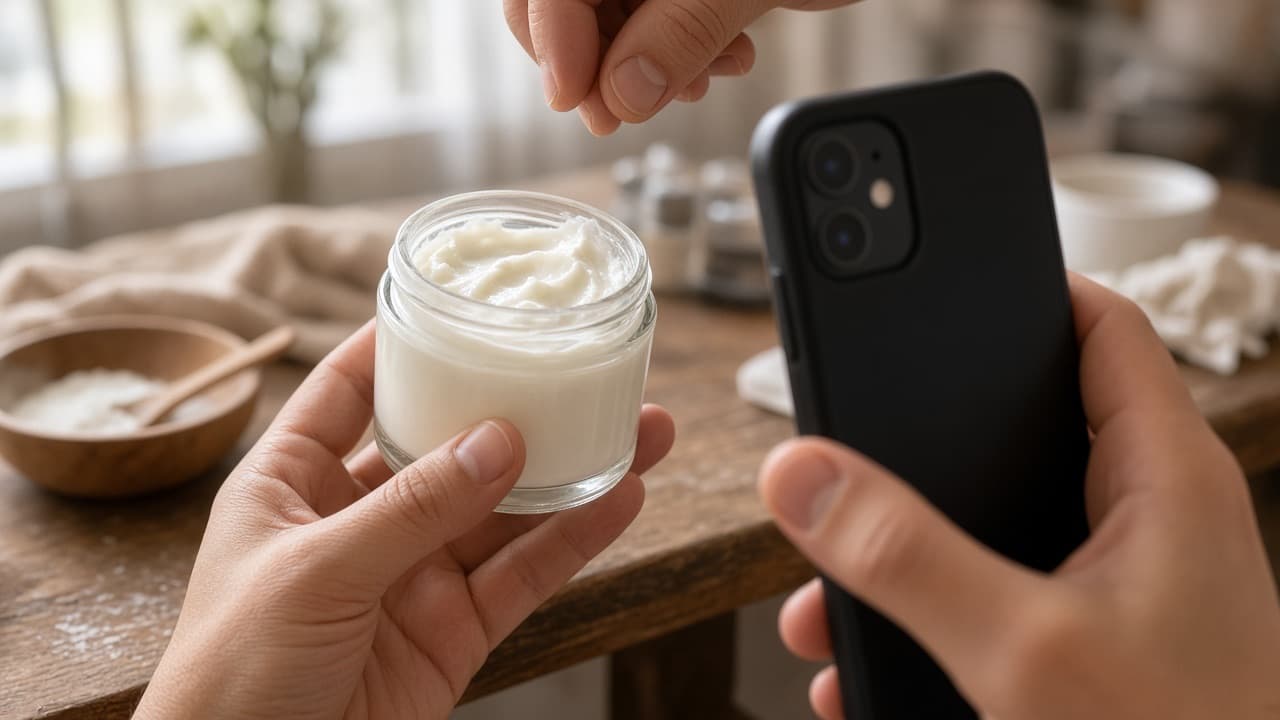
- —Motion in frame: texture, a pour, opening the pack — the picture stops a thumb faster than a sentence.
The hook always works in three layers at once: picture, on-screen text, and the first spoken line.
CTA
The call to action should be specific and natural: “Tap the basket under the video,” “the link is in the orange basket,” “on LIVE tonight the set will be a lower price.” One CTA per video. The impulse-purchase band differs by country. Above it you need more proof (a demo, reviews, a comparison). Below it, a good hook and a clear “why now” are enough. Learn the band for the market you sell in instead of copying a number from another country.
Content pillars
Instead of inventing every video from scratch, lean on 4–5 pillars and rotate them through the week. A beauty-brand example:
- 01Education — ingredients, routine, myths (“can vitamin C go with retinol?”).
- 02Product demo — texture, application, scent described in words, the effect after 10 minutes.
- 03Behind the brand — the lab, formulas, packing, the founder at work.
- 04Social proof — customer reactions, duets with comments, repeat purchases.
- 05Direct selling — sets, limited runs, LIVE announcements.
Testing formats
Do not guess — test. One product, 3–5 different hooks, the rest of the video the same. After 48–72 hours compare the share of views that pass the first 3 seconds, average watch time, product clicks, and conversion. Copy the winning hook onto the next products. Drop the loser without sentiment.
The mistakes new brands make most often
- —Copying ads from another platform 1:1 — too polished, no person, no hook.
- —Posting once a week. The algorithm learns an account from regularity — at the start aim for 1–2 videos a day.
- —A catalog that is too wide at the start, instead of a few hero products.
- —No LIVE. Livestreams are one of the strongest selling formats on TikTok Shop.
- —Measuring views instead of sales and product clicks.
- —Waiting on creators “until the brand grows” — affiliates, Open, Target, and samples.
- —Copying another country’s fee table, document list, or follower threshold into yours.
Instagram, sessions, and ebooks at this stage
Instagram opens on Reels, which account for about half of time spent on the platform. The same TikTok videos can go out as Reels (without a watermark), and new hooks can be tested with Trial Reels, which shows the clip only to people who do not follow you. Carousels go up to 20 slides and have a “second chance” mechanism — useful for education from pillar 1.
Your own online sessions — a short LIVE or a free webinar on the customer’s actual problem — are the simplest way to turn reach into a mailing list and a base for the next launches.
An ebook can work as a lead magnet from day one: a free guide in exchange for an email collects people who arrived from TikTok into a channel that belongs to you, not to the algorithm.